
After the Reading: A Five-Minute Tarot Journal

A long email can feel clear when you first read it and surprisingly hard to remember a week later. Before closing it, copy one sentence that held your attention. It might be the sentence you disagreed with. That reaction is often worth keeping, too.
Make a note small enough to finish
Write three lines: “The sentence I noticed,” “What it brought to mind,” and “What I want to watch for.” For a reading about reconnecting with a friend, the last line might be, “Do our plans feel easier when we choose a day before ending the call?” You’ve given yourself something specific that can show up in ordinary life.
Put a date on the next page
Come back in a week. Write what happened in plain language before rereading the interpretation. Maybe you had that call, maybe the plan fell through, or maybe another friendship took your attention. A journal has room for all three. Over time it becomes a record of your own observations alongside the cards.
Spend the first minute with the original question
At the top of the page, write the date and the question exactly as you sent it. A week later you may remember it quite differently. “How can I feel more at home in this city?” can quietly turn into “When will I meet someone?” if a date happens to be on your mind that morning. Keeping your original wording gives the entry a fixed point. If the question has changed, give the new version its own line and a date.
I like using whatever is already within reach. That may be a receipt tucked into a paperback, an email draft addressed to yourself, or a notebook you use for grocery lists. A beautiful empty journal can introduce an unexpected obligation to write beautifully. Most of my favorite observations would fit on the back of a bus ticket. If you’re writing about something private on a shared phone, choose a place to save it that you feel comfortable returning to.
A page from an imaginary reading
Imagine a woman named June who has just moved into an apartment above a laundromat. She knows the opening hours downstairs and the name of the dog next door. She doesn’t yet have anyone to text on a rainy Saturday. Her tarot question was “What could help me feel a little more settled here?” In this example, the reading brings up the Three of Pentacles and the possibility of finding familiar company through something people do together.
June’s first entry could be three sentences long. “I noticed the part about doing a job alongside somebody. At the library last night I felt more comfortable putting chairs away than trying to join the big conversation. I’ll pay attention to who stays afterward next time.” That’s a finished entry. She doesn’t have to promise to attend every library event, decide who her future friends will be, or produce a breakthrough about moving. She has noticed one moment she might otherwise have forgotten.
If June opens the notebook a week later, she may have something quite modest to add. “I helped stack chairs again. The man who runs the mystery club remembered my name.” Or perhaps she writes, “I was too tired for the library and enjoyed a long call with my cousin instead.” Both entries say something about finding her feet. A journal that only accepts events matching the reading can miss the most interesting part of the week.
Use one margin for your own objections
It’s possible to like a reading overall and wince at a single line. Circle that line and let yourself be specific. “I disagree” is a start. “I don’t think I’m afraid of moving; I think I’m tired of being the one who packs our kitchen every time” tells you much more. A strong reaction can reveal a detail that never made it into the original question. It may also mean the interpretation simply missed the mark for you.
When I reread a page, I enjoy seeing the marks of disagreement because they preserve a particular afternoon. The word “freedom” can feel exciting in March and exhausting in May, after two more changes of plan. If you erase the old entry to make room for the new one, you lose that change in meaning. Date the second thought beneath the first. There is no requirement to make the two agree before closing the book.
Give a card a picture you can remember
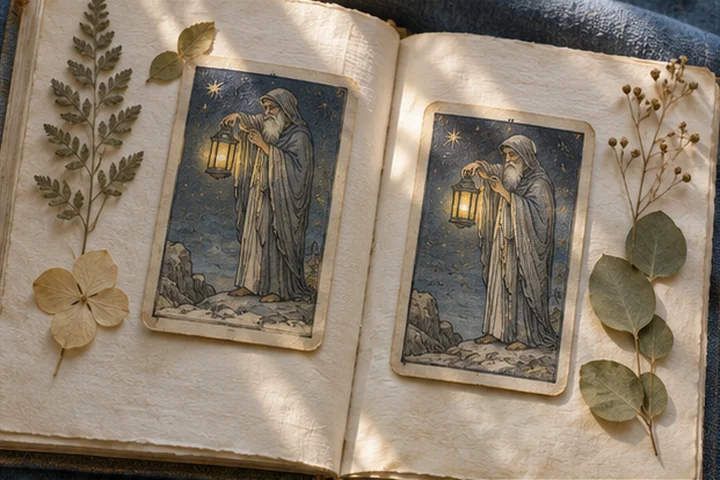
If a card from your reading stays with you, copy its name onto the facing page. Under it draw a detail from memory. Stick figures are fine. Perhaps it’s a pair of boots by a river, a hand around a cup, or a lamp just above eye level. Then write what the detail reminds you of in your own life. A small lamp could bring back the porch light your grandmother left on when anyone was coming home late.
You can do the same thing if the email contains only the card’s name and interpretation. Instead of trying to reconstruct an illustration you haven’t seen, draw your own object beside the line that moved you. June might sketch the outline of a folding chair. That chair would be enough to bring the whole library evening back several months later. The sketch’s job is to keep the memory within reach. You needn’t show it to anyone.
Make uncertainty easy to record
Try giving each entry a small blank for “What I don’t know yet.” It’s a particularly useful space after a love reading. “I know I enjoyed our dinner. I don’t know whether we’re looking for the same sort of relationship.” These two sentences can live quite comfortably beside each other. In the days that follow, a direct conversation can answer the second one. Until then, a question mark is a fair and accurate description of where things stand.
In a year-ahead reading, that blank might stay open longer. Pick one date near the end of the current month and write it beside the relevant paragraph. Skip months you haven’t reached. When your reminder comes around, add one specific event and one thing you had expected to feel differently about. If the whole month has been a blur, look at your calendar or a photograph first. Those records can return you to the actual week more quickly than trying to summon a mood.
When the five minutes are up
Stop in the middle of an idea if that’s where the timer catches you. Leave a few words for tomorrow: “the red suitcase,” “the lunch I almost canceled,” “ask what she meant by home.” A fragment can be a much better invitation to return than an elaborate assignment. On a busy day the page may contain one sentence, in which case the five-minute journal has taken thirty seconds and done its job.
After several entries, read just those last fragments. You may notice a running interest that wasn’t obvious within any individual reading. Perhaps you keep paying attention to invitations you almost decline. Perhaps the same park bench shows up in two otherwise unrelated stories. Pick one favorite detail and put a star beside it. The record you have made is a small part of your life observed closely, in words you’ll still recognize as yours.