
The Lovers and the Two of Cups: What Changes in a Love Reading?
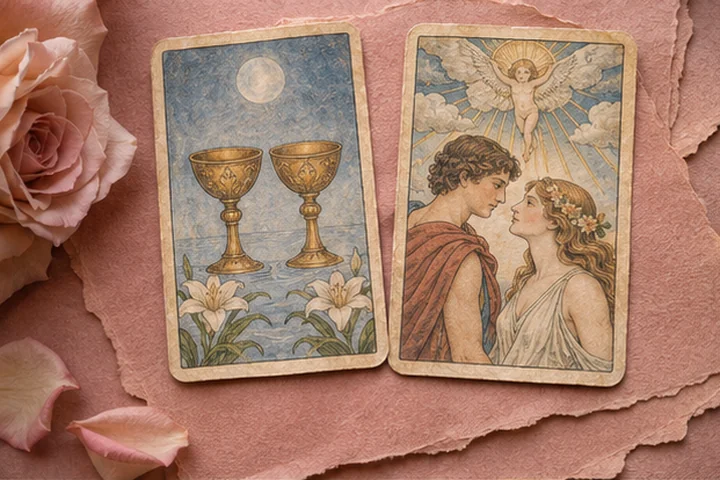
Picture two people who love spending weekends together. One would like to live together soon. The other wants to keep separate homes. There’s affection in the room, and there’s an important choice. This is the kind of situation where the distinction between the Two of Cups and The Lovers becomes interesting.
Look at the exchange
With the Two of Cups, I’d start with what each person offers and receives. Who starts the conversation? Can both people speak plainly and still feel heard? A small reciprocal gesture, like each making room for the other’s plans, might matter more here than a grand declaration.
Look at the choice
With The Lovers, I’d turn toward the values behind the decision. Perhaps one person associates sharing a home with commitment, while the other associates having space with being a good partner. Which meaning has each of them assumed the other shares? Draw these cards together and you have two questions worth keeping separate: “How do we meet each other?” and “What are we choosing together?”
Two cards, two moments in the same evening
Imagine a couple sitting at the kitchen table on a Sunday night. One person pours tea for the other and remembers exactly how much milk to add. It’s a small gesture with years of intimacy behind it. Then a job offer enters the conversation. Taking it would mean moving six hours away. The warmth in the room is genuine, and so is the disagreement that follows. It’s quite possible to share the first moment beautifully and still have no idea what to do about the second.
The Two of Cups gives me a way to read the tea. Look at the two people facing each other, each holding a vessel. Each brings something to the exchange. In a reading I might ask what each person felt able to offer that evening. One had the courage to mention the offer before deciding. The other stayed at the table long enough to ask what the opportunity meant. Neither detail settles the question of moving, but both tell us something about how the relationship works under pressure.
The Lovers gives me a way to read the next morning. An offer usually comes with a deadline. Even putting the discussion off has consequences. I’d ask what each person believes a partnership asks of them when two good things point in different directions. To one, supporting a partner means moving together. To the other, support includes allowing each person to keep the work and community they have built. Naming the values makes the conversation less personal in the most helpful sense: neither has to be cast as the one who loves less.
The question changes the emphasis
If you’re single and ask what to look for on an early date, the Two of Cups could bring the ordinary rhythm of a conversation into focus. Does the person who asks about your work listen to the answer? Do you get curious about their life in return? On an early date, a mutual exchange of attention may be more informative than a dazzling opening line. It also gives you something you can notice without guessing the other person’s intentions.
With The Lovers in that position, I might ask which part of yourself you find easiest to set aside when you want someone to like you. Perhaps you say you’re open to moving anywhere when you know you’d rather stay close to your family. Try saying the honest version on the next date. Compatibility has a better chance to show itself when both people are actually present in the conversation.
When the cards fall in an unexpected position
Draw the Two of Cups as the difficulty in a reading about a new partnership. The usual emphasis on harmony can become interesting here. Maybe you’re both so eager to agree that nobody admits how much the weekend trips cost. Both keep saying “anywhere is fine” when choosing a restaurant, then quietly resent the bill. The card might invite one honest difference into a relationship that has learned how to be pleasant. Even a very kind exchange can leave a practical matter untouched.
Or draw The Lovers as a strength after a difficult separation. I would resist rushing to a reunion story. The strength may be the ability to make a choice that fits the life you want, even while there is affection on both sides. Think about the last promise you made to yourself and actually kept. That, too, can be a way of honoring love in a reading that begins with loss.
Put the two questions on paper
Take a page and give it two headings, “Exchange” and “Choice.” Under the first, write something that passed between you in the last week: a ride home, an apology, a piece of good news shared first with one another. Under the second, put a decision that is waiting for a real conversation. Maybe you’ve been assuming a holiday invitation is settled when your partner thought it was only a possibility. The headings let the affectionate gesture remain meaningful without asking it to answer a question it never addressed.
If you send me a question about these cards, mention the position each occupied and what was happening when you drew them. Two names and a photograph of the spread tell one part of the story. “We’ve agreed that we want to live together, but we’ve never talked about where” tells the part that gives the reading its direction. It may turn out that the most important word in your question is a very ordinary one, like “where.”