
When a Reversed Card Shows Up
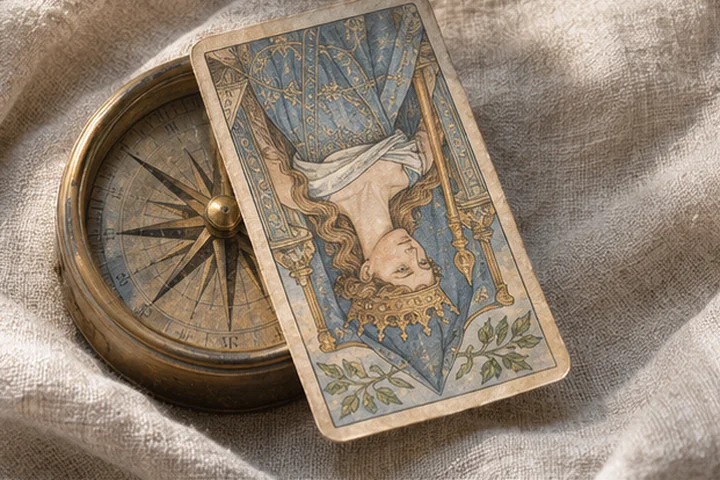
Turn a familiar card upside down and notice what catches your eye first. A detail you usually skip might suddenly dominate the picture. Readers use reversals differently. Some read every card upright. Others take a reversal as a cue to explore a quality that is private, delayed, or difficult to express.
Try two interpretations before choosing one
Say you’ve asked about sharing a creative project and drawn the reversed Queen of Wands. One reading is that you’re holding back because you expect a harsh response. Another is that you enjoy making this particular thing in private. Those interpretations point in very different directions. Which one fits the situation you described before you shuffled?
Return to the wording
If your question was “What would help me share my work?”, a small first audience might fit. If it was “Why does this hobby feel exhausting lately?”, the pressure to show it publicly may be the very thing to examine. The same card can do a different job depending on the question it was asked.
A second look at the Queen’s sunflower
In a deck where the Queen holds a sunflower, cover the lower half of the picture with your hand. Look just at the way she holds the flower. Is she offering it to someone or simply enjoying it herself? Turn the card over, keep the same half covered, and look again. You may suddenly notice how firmly her fingers close around the stem. For a question about showing your work, that small detail gives me language for something quite particular: being willing to let someone look while still wanting to keep hold of what you made.
You can try that distinction in the example of a sketchbook. There is a considerable difference between opening it at one drawing for a trusted friend and handing over the whole book for someone to browse. Both count as sharing. One gives the artist control over what is seen. If that difference matters to you, it belongs in the reading. A reversed court card can become surprisingly down-to-earth once you give the person in the picture something ordinary to do.
Put the reversal in a position
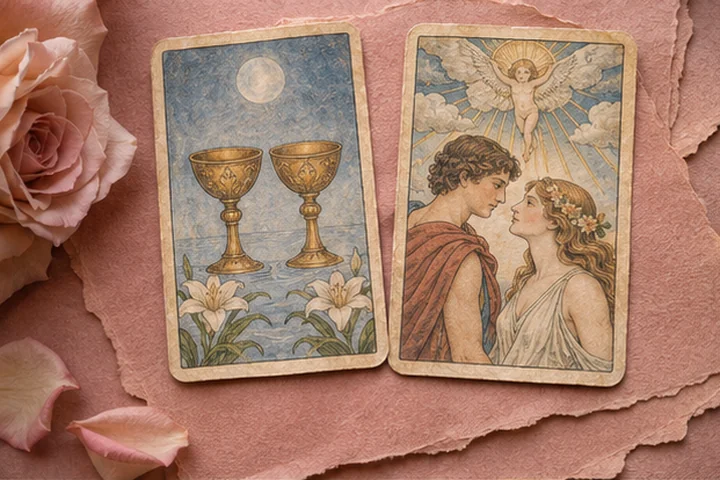
Suppose the question is about returning to a choir after a long break. You draw three cards for what draws you back, what makes it hard to return, and what might help at the first rehearsal. Let’s put the Three of Cups first, the Queen of Wands reversed second, and the Page of Pentacles third. Now the Queen has a specific job. She occupies the difficult middle of a story in which the company of other people is appealing and a small bit of preparation could help.
I can imagine the singer missing the laughter before rehearsal and still dreading the moment the director asks everyone to introduce themselves. The Page suggests something manageable: ask for the sheet music in advance and learn the opening bars of one song. These are possible details to check against the singer’s life. If the choir is welcoming and the real problem is finding a sitter on Thursday nights, an interpretation about stage fright adds little. Time, energy, and who gets to have a night out are also legitimate subjects for a Queen of Wands reading.
Move the same reversed Queen to the third position and a different idea comes into view. As the thing that might help, she could suggest permission to be rusty. The singer might stand toward the back, follow someone who already knows the piece, and leave the question of a solo for another season. Nothing about the drawing changed. Giving the image a different question to answer changed the way I used it.
When an upright meaning already fits
A reversal can tempt you into hunting for the cleverest possible interpretation. Imagine drawing a reversed Four of Swords after saying you have had houseguests for twelve days and would love an afternoon alone. I would begin with rest. Then I might ask what makes it difficult to claim the afternoon. Perhaps the guests are still there. Perhaps they went home yesterday, but the kitchen is full of dishes and you can’t settle while you can see them. Those would be two quite different afternoons.
Write a complete sentence using the simplest meaning you know. Read it aloud. If it makes immediate sense, add just one clause about the reversal. “I need an afternoon alone, and I keep saving it for the moment when every chore is finished.” That second half says more than a paragraph assembled from a list of reversed keywords. It also leaves room for a perfectly practical ending: leave the dishes in the sink for an hour.
Decide how you will handle turned cards
Before shuffling, choose a convention that feels comfortable. You might intend to read reversals throughout a whole spread, or decide that all of today’s cards will be upright. With a deck that has an obvious top and bottom on the backs, you may even know that a card is reversed before you see its face. None of that prevents you from having a considered reading. It does help to make the decision early, while you have no stake in which cards will appear.
When reading at a table with another person, agree whose viewpoint defines upright. A card upright to me across the table may be upside down to you. If it slides sideways when I turn it over, I follow the convention we started with. One accidental turn is a poor reason to change the emotional weight of a message. A written reading can simply name the card and indicate when its orientation influenced the interpretation.
A two-minute exercise with a familiar card
Choose a card you know well and invent a modest, specific question: “How could I enjoy Saturday’s potluck when I’ll know only the host?” With the card upright, write down a detail from the picture and one possible action. With it reversed, describe the same detail from the point of view of someone who prefers to ease into a group. For the Queen, that could be bringing a dish you enjoy talking about. A recipe creates a natural opening, and somebody else gets to decide whether to carry the conversation further.
Try the exercise again a week later with a different question. Keep both notes. Over time, you’ll learn which images genuinely change for you when turned and which remain remarkably steady. I’d rather read a simple observation that belongs to that particular Saturday than an impressive rule that could be pasted into every reading.